
Evolve or Disappear: Digital Marketing and SEO Are Becoming Increasingly Darwinian
Discover how to apply the principles of Darwin and Pareto to dominate SEO in 2025. Learn to focus on what actually drives results in digital marketing and keep your company at the top of Google.
SEO
Pedro Overbeck
4/10/20252 min read
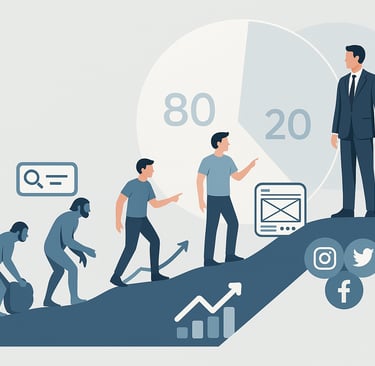
In 1859, Charles Darwin wrote that "it is not the strongest of the species that survives, nor the most intelligent, but the one most responsive to change." Originally aimed at biology, this phrase accurately describes the digital marketing landscape today.
SEO in 2025 is no longer an isolated technical discipline. It is a strategic tool in constant transformation. What worked two years ago might be completely obsolete today.
In this environment, the Pareto principle is a fundamental ally: 20% of your actions generate 80% of your results. The challenge lies in identifying and executing those actions with precision.
SEO as a process of natural selection
SEO is no longer about keyword stuffing or hoarding backlinks. The focus is on relevance, structure, and user experience. Search engines have evolved—and continue to evolve—to deliver not just answers, but great experiences.
Slow websites with confusing navigation or shallow content are losing ground. Meanwhile, those that adapt to algorithm demands and audience expectations are gaining relevance.
Companies that treat SEO as a living process, rather than a checklist, are the ones that remain visible.
What is changing in SEO in 2025
Several transformations are reconfiguring how SEO is thought about and executed:
Generative Search: With the introduction of AI-generated answers in search results, the competition for attention has increased.
Voice Search: Requires an adaptation in content language and structure, focusing on natural phrasing and objectivity.
Helpful Content: Algorithms prioritize deep, original content aimed at the user's true search intent.
Social Media Interaction: Platforms like TikTok, YouTube, and Instagram directly influence the search and discovery journey.
These changes demand a more integrated and strategic approach.
Pareto applied to digital marketing
Many companies make the mistake of trying to do everything at once: blogs, social media, ads, technical SEO, funnels, email marketing. The result is dispersed effort and low ROI.
Applying Pareto means focusing your energy on what actually makes an impact. Practical examples:
Improving pages that already get organic traffic, rather than constantly creating new ones.
Optimizing site speed and structure, which directly influence rankings and conversions.
Producing relevant, data-driven content, even if at a lower volume.
Being present on the right social networks with a strategic approach, instead of trying to be everywhere.
By identifying what drives results, you can reduce wasted time and budget.
How to become an adaptable company
Adaptability isn't a differentiator; it's a necessity. In digital marketing, this means:
Analyze frequently: Use data from platforms like Google Analytics, Search Console, and heat mapping tools to inform your decisions.
Test and adjust: Abandon practices that aren't working and adapt your strategies as the market shifts.
Integrate your departments: SEO, content, UX, and social media must work together. There is only one user, and their experience needs to be cohesive.
Adaptable companies aren't the ones that do everything, but the ones that do the essentials consistently.
Conclusion
The evolution of digital marketing doesn't favor those who do more, but those who do better. SEO is a dynamic field that requires attention, analysis, and the ability to respond quickly.
Following the Darwinian model in the digital environment means observing what is changing, understanding the signals, and reacting with focus. Backed by the Pareto principle, you can concentrate your efforts on what truly matters—and generate sustainable growth.